Fairfield's Speed Cameras: A Sourced Timeline
How the ordinance and plan actually moved — drawn entirely from the Town's own agendas, minutes, meeting videos, and contract records. Every claim links to a source you can check yourself.
The rule (Connecticut law)
These aren't optional formalities. In Connecticut a town holds only the powers the state grants it, and the state grants this one on conditions — so the hearing and the vote are the guardrails that decide whether the authority to run the cameras exists at all. (It's the same principle as zoning: a change made without the required public hearing doesn't stand.)
The timeline
Board of Selectmen regular meeting. The plan the town submitted to the state contains a section titled "Plan Approval Public Hearing Notice/Minutes" — and the minutes it attaches there are from this Nov. 20 meeting. But the word "hearing" isn't on the agenda; the only camera-related item was Item 6 — a ~2-minute vote to approve utility-pole encroachment permits ("no funding attached… any comments from the public? Seeing none"), with no plan presented and no public comment. In other words, a routine pole-approval vote is what the town designates as the statutory plan hearing.
▶ Watch agenda (Item 6)The ordinance (amendments to the Vehicles & Traffic Ordinance, §§ 102-4–102-17) is referred to the RTM's Legislation & Administration Committee. The agenda never uses the words "speed camera," "school zone," or "surveillance."
▶ Dec 9 ▶ Dec 16 agenda (Item 22)Presenting the ordinance, Rep. Michelle McCabe tells the RTM the Traffic Authority will "develop a plan," that "the plan needs to have a public hearing," and only then does it go to the state — the Moderator repeats the sequence. On the agenda it's buried as Item 16: "amendments to the Vehicles and Traffic Ordinance, §§ 102-4 to 102-17."
▶ Watch agenda (Item 16)First consideration. Rep. Myke Hartigan says he's "assuming there will also be a public hearing as is required by State Statute" at the plan stage; the Police Chief's reply is non-committal.
▶ Watch agenda (Item 16)Standing-committees night. On the recorded plenary the item got a brief "any questions?" (~4 minutes, police chief absent, no public comment) and was "not considered" for a floor vote. The Public Health & Safety Committee then moved it out 5–1 (Rep. Ludwiczak abstaining) in the breakout afterward — which isn't part of the video — to tee up the Feb. 24 vote. One of the "four meetings" reps cite.
▶ Watch agenda (Item 11) committee minutesThe RTM adopts the ordinance 32–6. Four residents speak in public comment, all in favor. The plan version later submitted to the state designates this ordinance meeting as its "public hearing" — though it was a meeting to adopt the ordinance, not a noticed hearing on the plan, and it came before the plan even existed.
▶ Watch agenda (Item 11)The vendor contract is approved 2–0 at a 4:00 pm Friday special meeting — nine days after school let out for the summer, with Selectwoman Kupchick absent and no public present. The motion authorizes a term "not to exceed three (3) years" — but the signed contract runs five (5) years, extendable to seven.
▶ Watch agenda (Item 3)The vendor's data contractor (NDS) runs the speed studies at the school zones — about five weeks after school let out on June 11. No children present, no crossing guards, and the reduced 20 mph school-zone hours not in effect. These summer measurements produced the "typical" (85th-percentile) speeds of 32–38 mph the plan relies on. (One Ludlowe site was also studied Aug. 4–8.)
the town's plan (state site) ↗The vendor presents the six-zone, 16-camera plan to the Traffic Authority — expressly "a discussion item, not a voting item," with no public comment taken (a resident who tried was directed to the website). It's submitted to the state the very next day, Aug. 22, 2025. (The agenda lists it as a "discussion" item, and public comment is heard only "before all voting items" — so no comment window applied.)
▶ Watch agendaPlan submitted to the state (OSTA Report No. 050-2404-01), built on the July speed studies above plus older 2022 traffic data. After OSTA requests more information, its 60-day review formally begins Sept. 15, 2025; the plan is approved Dec. 11, 2025 (amended May 1, 2026).
The budget was counting on the money. At the Board of Finance quarterly review, members note the town "budgeted over a million dollars for those cameras" and worry about a "huge hole" in the budget if installation slips past the fall. Capt. Irizarry walks through the vendor/permit timeline and candidly doubts whether cameras change behavior — "this is new to Connecticut… I don't know what to expect" — noting drivers may just speed up between cameras. The stated goal is "to slow people down, not revenue" — yet the FY26 budget assumed the revenue.
▶ Watch agendaCameras go live. Fines are set at the state maximums ($50 / $75) plus a $15 fee. Officials reported roughly 114,000 violations in the first ~18 days.
Public information meeting (~200–300 residents) — held after the cameras were already live.
▶ WatchSelectwoman Kupchick urges the RTM to hold a public hearing and vote on the specifics, as Greenwich's RTM did; First Selectwoman Vitale declines to pause the program.
▶ Watch agenda"Recommit," not reopen. In her town newsletter, First Selectwoman Vitale writes that the town has "asked the RTM to recommit to the speed safety camera program via a vote" in August — calling it "another opportunity to be heard" and a chance for representatives to "suggest further revisions … if they so choose." But a vote to recommit to a program isn't one of the RTM's legislative powers (it can adopt, amend, or repeal) — so it can't retroactively supply the public hearing on the plan the law required before submission. The part worth pressing is her own invitation: to revise the specifics — the hours, the fines, and the data rules — out in the open.
The Governor weighs in. Governor Lamont asks the state's police standards council (POST) to issue guidance within 30 days on camera and license-plate-reader technology — how long data may be stored, how it may be used, and whether it may be shared — and urges every municipality to pause installing new cameras and ALPRs until that guidance is out. Fairfield has nine additional camera zones already filed with the state.
Press release ↗ The letter ↗The vote appears — worded carefully. The Town Clerk posts the warning for the Aug. 24 RTM meeting. Item 5, recommended by the First Selectperson, asks the RTM to resolve that it "hereby confirms the Plan and its continuation, as submitted to and approved by the Connecticut Department of Transportation." Note the sequence: the statute required a public hearing and a legislative vote before the plan was submitted in 2025 — this asks the RTM to confirm it a year after the state approved it. You don't need a vote to confirm something that was already lawfully authorized. Item 6 (six co-sponsors) would create an Ordinance Drafting Committee to review the camera ordinance — the process door, opening.
Agenda / warning ↗ Full packet ↗The town's own numbers arrive. The RTM's August backup packet includes the CFO's first accounting (through June 30): 25,430 citations mailed, $1,271,500 in fines billed, and an Altumint fee of $381,450 — exactly $15 per citation. It also discloses that citations went out with the wrong fine amounts during rollout (~$104,200 worth), that police rejected 6,239 of the vendor's 35,099 flagged violations (about 1 in 6), and that 948 citations are under appeal against a hearing capacity that, through July 22, had heard 13 — of which 8 won. The packet also contains the RTM item actually on the table: six representatives propose an ordinance drafting committee to review the camera ordinance "in light of data … and public feedback." A review committee is progress — but it is not the public hearing on the plan, or the vote to submit, that § 14-307e required.
The informational meeting says the quiet parts out loud. At the RTM's informational session, asked what happens if the body votes no on the "recommit" resolution or tables it, the answer on the record was that it "doesn't actually change the operational plan — that would continue at this point," with the First Selectwoman explaining she wants "shared responsibility and a shared ownership" of the program. So the Aug. 24 vote changes nothing either way — by the town's own account. Other on-the-record statements from the same meeting: license plate numbers are retained for a year to catch repeat offenses (the ordinance promises destruction within 30 days of resolution); the appeals hearing officer and hearing clerk are paid from ticket revenue; the revenue sits in the general fund offsetting paving costs, not in a dedicated account; "there's a direct expense that's paid to the vendor … a cost per ticket"; the town's Flock contracts "are ended" and its license-plate readers now run on Axon, for law-enforcement use; and future cameras "would have to … go through the approval process and a public hearing" — a concession that invites the question of where the hearing for the first six was.
▶ FairTV CT Insider coverage ↗The open questions
- Where is the notice, agenda, and minutes of the public hearing on the plan the law requires before submission? (The Town's own filings point to two different meetings — neither noticed as a plan hearing.)
- Where is the vote of the legislative body to submit the plan to the state? (Under the Town Charter § 4.1 the RTM holds the ordinance power; under the C.G.S. § 7-193 default it would be the Board of Selectmen — but neither took a submission vote, so the question stands either way.)
- How did a contract the Selectmen authorized "not to exceed three years" become a signed five-year agreement?
- Which retention rule governs — the 30-day data destruction the town's ordinance and privacy policy promise residents, or the 90-day window (written to Florida law) in the signed vendor contract? On Aug. 17 the town answered part of this out loud: plate numbers are kept for a year to catch repeat offenses — a third timeline, and the one that least resembles the ordinance. Asked how the vendor's deletion is verified, the answer was "that's what I'm told."
- The town's ordinance (§ 102-7) says a vendor's fees "may not be contingent on the number of citations issued or fines paid." The signed contract pays Altumint $15 per paid citation — $381,450 so far — collected through a vendor-controlled lockbox account, with the town paid its share "net of Fees." At the Aug. 17 meeting this was confirmed plainly: "there's a direct expense that's paid to the vendor … it's a cost per ticket." How is that consistent with § 102-7 — the very provision the Town Attorney cited on the floor in February 2025 to explain why fees can't be contingent on fines?
- On July 6, 2026, a resident records request (Town Request 26-506) asked for the documentation at the center of the ALPR debate: the executed Axon contract (a multi-year agreement the FY27 police budget lists at $3,383,964, including the "Fusus" real-time crime center, ALPR integration, and drone technology), the records of the Flock review and cancellation, data-retention periods, data-sharing settings and access logs (including any sharing with federal agencies), and whether facial recognition is enabled or prohibited. As of Aug. 19 — 44 days later — the town has produced zero documents beyond a day-one acknowledgment, despite § 1-210(a)'s requirement of prompt compliance. If the department's technology review was as rigorous as officials suggest, the town is sitting on its own best evidence.
- The contract also gives the town, free of charge, one Flock license-plate reader and one Flock Condor camera per speed camera — up to 24 additional surveillance devices — with the LPR rollout to begin "immediately" once the cameras started citing, and the town responsible for their "applicable laws, data rules and retention." Were the Selectmen told they were approving an ALPR deployment? Does the town have an ALPR policy? Have any been installed? Next door shows what's at stake: Westport's own Flock transparency data reportedly logged 54,796 outside-agency searches in a single month, most under the generic label "Investigation," with out-of-state police among the top users — and Windsor and Killingworth have since terminated their Flock programs. 06880 (Westport) ↗
How Greenwich handled it
The lesson isn't "cameras are bad." It's that doing the process properly is achievable, doesn't tank the program, and restores trust — which is all anyone here is asking for. CT Mirror ↗
What happens next: The fight moves to the ordinance drafting committee — the hours, the fines, the appeal process, the data rules, and the vendor's per-ticket fee are all on its table. And on Sept 1, the Board of Finance takes up the program's first financial report — numbers the RTM never saw before its vote. Tell your representatives what the committee should fix →
Questions for the ordinance drafting committee
- The plan hearing. State law (§ 14-307e) required a public hearing on the camera plan — the locations, hours, and fines — before it was sent to the state. Which meeting was that hearing, and where is its public notice?
- The vote to submit. The law also required a vote of the legislative body to submit the plan to the state. When did the RTM or the Board of Selectmen take that vote?
- Recommit vs. revise. Item 5 asks you to "confirm" a plan the state approved a year ago — and on Aug. 17 this body was told, on the record, that voting no or tabling it "doesn't actually change the operational plan." If the vote changes nothing, what is it for — and will anything tonight actually amend the hours, the fines, or the data rules?
- Who judges the appeals. On Aug. 17 the town confirmed the appeals hearing officer and hearing clerk are paid out of ticket revenue. Should the person deciding whether a ticket stands be funded by the tickets being upheld?
- The fines. The $50 / $75 fines and the $15 fee are all state maximums, and the town chose the maximum on each. Will the RTM lower them, or explain why the max is right for Fairfield?
- Data retention. The town's privacy policy promises our data is destroyed within 30 days of a paid fine — but the signed vendor contract says records are kept up to 90 days, citing Florida law. Which one actually governs, and how long is our plate data really kept?
- Repeat-offender tracking. If our data is deleted at 30 days, how does the system charge the higher "second violation" fine months later? Is a repeat-offender history kept — for how long, and does it ever reset?
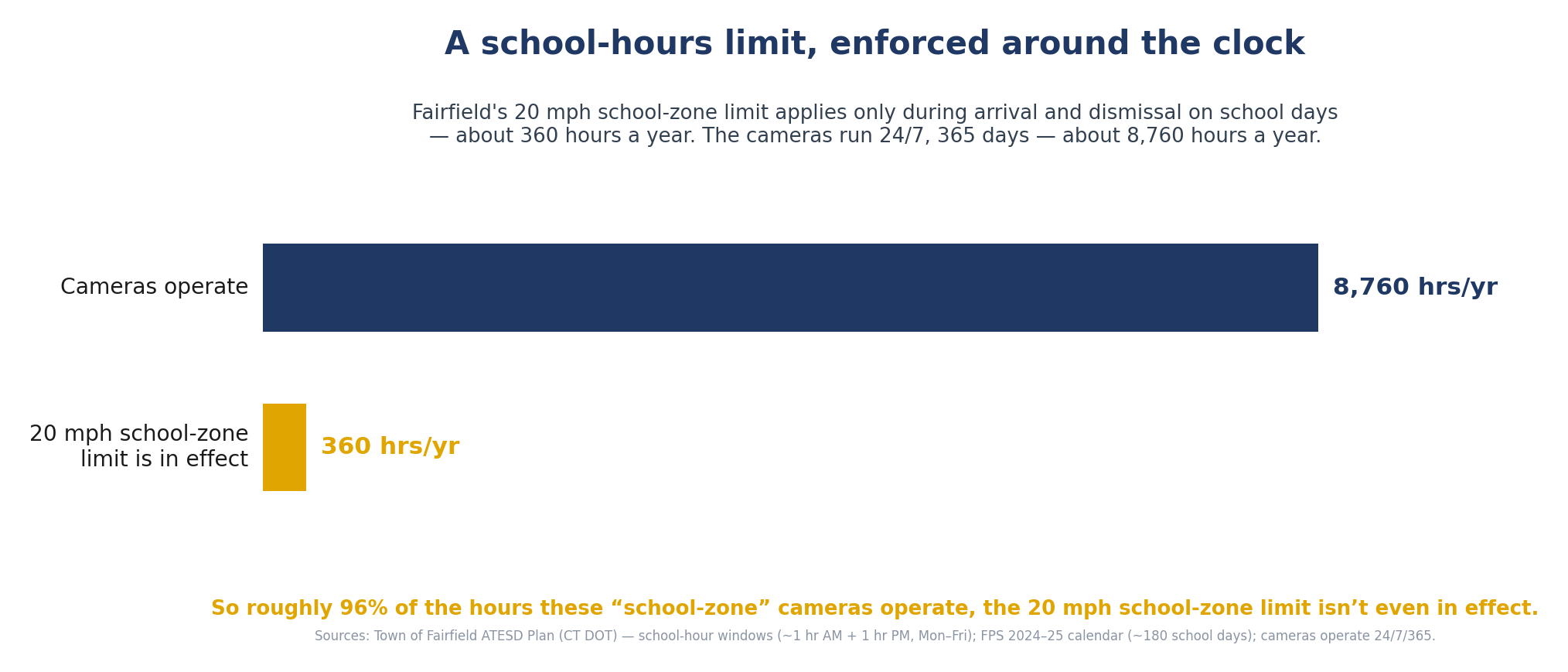
- The hours. The safety case is about school hours, but the cameras run around the clock and the speed studies were done in summer with school out. Will enforcement be tied to actual school activity?
- The evidence. Will the town publish the data that would let residents judge the program independently — violation and crash rates per vehicle (with traffic volumes), a consistent before-and-after, and a comparison road without cameras — rather than just raw violation counts?
- The vendor's fee. Our own ordinance says vendor fees can't be contingent on citations issued or fines paid — yet Altumint is paid $15 for every paid ticket, $381,450 so far. How is that consistent with § 102-7?
- The license-plate readers. The contract bundles in free Flock license-plate readers and Condor cameras — one of each per speed camera — and makes the town responsible for their data rules. The Governor just asked the state to review exactly this technology. Has any of it been installed, and where is the town's ALPR policy?
- The month hidden in plain sight (correction). We previously said July's data was missing from the RTM packet. It wasn't — and we've corrected the record. The July numbers (25,458 citations in June, 25,045 in July, essentially flat) were in the packet all along, inside the police department's report — on scanned image pages with no text layer. Search the 269-page packet for "July" or "25,045" and you get zero results; screen readers get nothing. Half the packet (134 of 269 pages) is photographs of paper. The transparency problem is real, just different: post documents as searchable text, which costs nothing and is also an accessibility requirement. And the arithmetic question stands: the report claims an 88% drop in speeding events while ticket output fell 1.6% — and the report's own Section 3 explains why: the 20 mph school-zone limits were suspended for the summer on June 16, so the "events" measuring stick changed mid-series. Which number describes the road?
- The exit clause. If anyone says we're locked into a five-year contract: the agreement allows either party to terminate for convenience after one year on 90 days' notice, without damages. The town has options — will the RTM use that leverage to renegotiate the terms?
- Who adopted the report? Monday's Item 4 delivers "a report from the Traffic Authority" under § 102-19 — and the Business Journal had its contents by Aug. 13. But the Traffic Authority's own Aug. 20 meeting, four days before delivery, never discussed the report, never voted to adopt it, and never mentioned the RTM at all. When did the body whose name is on this report actually take it up in a public session?
- Can the oversight body even receive comments? At its Aug. 20 meeting, the Traffic Authority acknowledged receiving "hundreds" of speed-camera emails that, until this week, went to only one to three members — routed through a personal Gmail account the chair created, which Google twice suspended as suspected spam, losing correspondence both times. Members said complaints "died on the vine" for weeks. Residents who wrote in and heard nothing deserve to know their comments may never have been read — and the drafting committee should give this body a real intake system.
- The cost of losing an appeal. The ordinance (§ 102-12(F)) says a resident who contests a ticket and loses "shall" be assessed "fines, penalties, costs, and fees" — but nowhere defines or caps what those penalties, costs, and fees are. What can losing an appeal actually cost, in writing? Residents deciding whether to contest a ticket deserve to know before they ask for a hearing.
From the town's own records
- What the RTM was told, in the sponsors' and officials' own words (Feb. 24, 2025). When the ordinance passed, First Selectman Bill Gerber walked the body through his math on the record: an average ticket of $62.50 against the $875,000 already budgeted works out to "about 130 tickets per site per month," which he said "doesn't seem like a lot to me" — adding, "if it's zero, I don't think anyone will be upset about that," and that he expected "a big drop" in ticketing within a couple of years as drivers adjust. Chief Kalamaras, citing a vendor analysis for Milford, put the aggressive end at "$2.3 million for the first year" and called Gerber's budget figure "very conservative... it could be $500[K], it could be $1.5 [million]." The actual program: roughly 1,560 tickets per site per month, about twelve times Gerber's stated expectation, billing at an annual pace of roughly 25 times the budgeted revenue and five times Kalamaras's most aggressive scenario. The machine that exists was never described to the people who voted for it.
- The Sept. 1 Board of Finance meeting: the first financial review any board ever held. Three months into billing, the program's first financial report reached its first governmental audience — revised twice before the meeting, the second revision (posted 2:09 pm the same day) restating gross revenue upward by $771,030 because the original had understated what drivers are billed. On the record that night: appeal hearings are closed to the public on "legal guidance" (one member: "we don't live in a kangaroo state; hearings should be open"); the board could not learn why the police rejected 6,239 violations in June but only 617 in July, the swing that kept ticket output near 25,000 a month while measured speeding fell; one member asserted, over another's disagreement, that citations are being dismissed because the town "didn't follow the proper procedure" in enacting the program; the nine additional school-zone sites are already under OSTA review; and the First Selectwoman told the board the town is bound by a year commitment and cannot give 90 days' notice, though the contract's § 10(B) allows either party to terminate for convenience "after one year" — a clock that arguably ran out in June 2026, a question that deserves a written answer from the Town Attorney.
- How other Altumint towns are faring — and paying. Warwick, RI pays Altumint $2,485 a month per camera plus $7.80 per citation; Fairfield's contract is the opposite bet: $995 a month plus $15 per citation. The two structures cost the same at about 207 citations per camera per month. Below that, Fairfield's deal is cheaper — and 130 per site per month is exactly what the RTM was told to expect. The actual program runs at roughly 1,560 per camera per month, where Fairfield's structure costs about $24,400 per camera per month all-in versus about $14,700 under Warwick's — roughly 66% more, at the volumes this program actually produces. (Separately, the town's finance report shows camera fees of $1,995 per camera per month, not the contract's $995 — an unexplained $192,000 a year.) Elsewhere: in Winchester, VA, a court dismissed the program's first citations and the police chief publicly faulted Altumint's support, and Milford's Board of Aldermen paused its Altumint cameras and license plate readers — the same motion Fairfield's RTM rejected 9-29.
- Every ticket payment goes first into a bank account controlled by the vendor ("lockbox"), which deducts its fees and sends the town its share monthly — the vendor pays itself first.
- The contract has a confidentiality clause: both sides agree not to disclose information about the program's performance "except as required by law, or by mutual agreement."
- Fairfield police rejected 6,239 of the 35,099 violations the vendor's system flagged — about one in six. Human review is doing real work.
- The town's one-citation-per-month cap quietly spared residents 3,430 tickets (about $171,500).
- Citations went out with the wrong fine amounts during rollout — roughly $104,200 worth. (Residents were undercharged; the vendor is compensating the town, not the other way around.)
- Of appeals actually heard by July 22: 8 of 13 won. When residents finally get a hearing, the tickets lose 62% of the time. There are 948 more waiting, so hearings are moving from 24 every two weeks to 75 every Friday.
- The town told residents the cameras "operate only during school hours" (town FAQ) — while the plan filed with the state says enforcement "will be 24/7." Both documents appear in the same RTM packet.
- The vendor's own report shows the sites are wildly different: one Riverfield stretch measured 3–7% of drivers speeding; a Burr stretch measured 33–55% — yet the terms are identical everywhere.
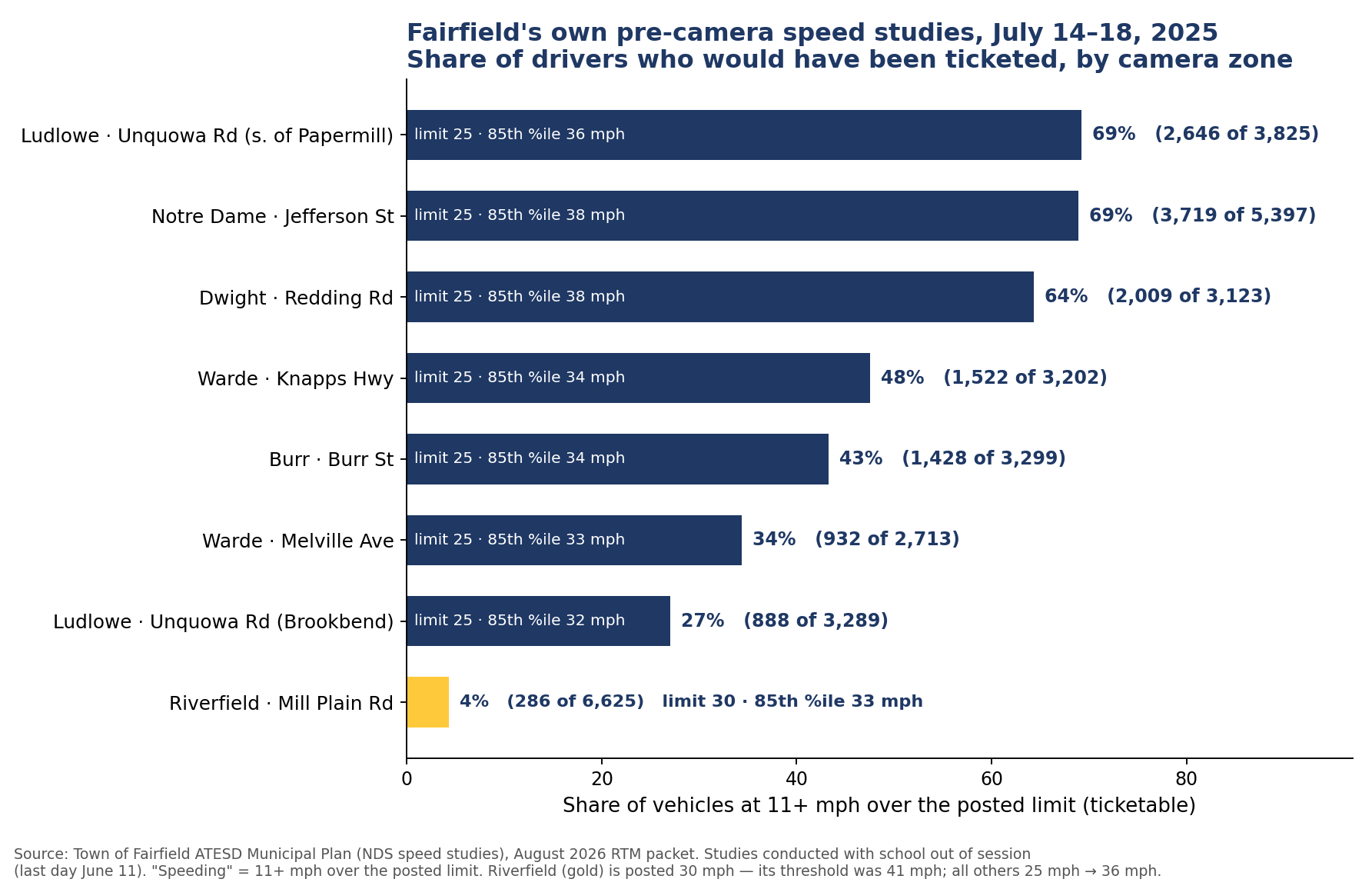
The town's own July 2025 studies, charted. Note the gold bar: Riverfield's drivers travel at nearly the same speeds as Melville Avenue's (85th percentile 33 mph on both) — but Mill Plain is posted 30 and Melville 25, so one road shows 4% "speeders" and the other 34%. The label depends heavily on the number on the sign — a fair question for an engineering review before 24/7 enforcement. - Roughly 3 out of 4 tickets go to non-residents (76.9% in June, 78.5% in July, per the vendor's report) — and the top source is Bridgeport, whose ZIP codes fill five of the top ten. Whatever your view of the cameras, Fairfield's camera revenue is largely paid by commuters from a neighboring, less affluent city.
- The town's ordinance (§ 102-19) requires the annual report to state how many vehicle owners received more than one violation. The report in the August packet omits that number — even though the system plainly tracks repeats (its one-ticket-per-month cap suppressed 3,430 citations). A fair question for the drafting committee: where is it?
How would we know if it's working?
- Rates, not raw counts — violations per 1,000 vehicles, with traffic volumes. A big number can just mean a busy road.
- A consistent before-and-after — the same speeds measured the same way before the cameras, during the warning period, and each month after. (The plan's "before" speeds were measured in July, with school out.)
- The real safety outcome — crashes and injuries at each site, not just violation counts.
- Comparison roads without cameras — to separate the cameras' effect from town-wide trends like the education campaign or seasonal slowing.
- School-hours vs. off-hours — since the safety case is about school hours, but the cameras run around the clock.
- Unique vehicles, same methodology throughout — the town has cited a drop from 94,000+ warnings in May to about 8,000 in early June. But May counted warnings with no cap (one commuter could generate dozens), while June issuances were limited to one per vehicle — so part of that drop is the counting changing, not the driving. And the numbers don't reconcile: 94,000 May warnings, yet the CFO reports only 35,099 violations ever submitted for police review through June 30. Four different counters are in circulation — vendor "events," warnings, violations submitted, citations mailed — and officials quote whichever suits the moment. The fix is simple: publish unique vehicles detected per month, same method every month. That number can't be inflated by repeat-counting or deflated by caps. If it fell sharply, the cameras work, and the data will say so.
Ask the town to publish this before the RTM votes. If the program works, the data will show it.
And is the limit even set right? A 20 mph limit makes sense when children are actually crossing — but these cameras run around the clock, and the town's own studies clock normal traffic at 32–38 mph on these roads, with tickets triggering at 31. Outside school arrival and dismissal, that means ticketing ordinary drivers for going the speed the road was engineered for — not catching dangerous ones. A police officer uses judgment; a camera has none. A real safety program would tie enforcement to when kids are present and to genuinely unsafe speeds — the specifics the RTM should set in the open.
All the meeting records
- The August meetings: Agenda & warning (Aug 17 informational · Aug 24 regular) · Backup packet — the CFO's citation-revenue memo, the police department's program report (pp. 3–57, scanned), the full ATESD plan, and the Item 5 & 6 resolutions · Aug 24 meeting video.
- The first financial report (Sept 1 Board of Finance): the inaugural ATESD Operations and Financial Report — violations submitted and approved (35,099→26,589 submitted; approval rate 82.2%→97.7%), gross revenue ($1,375,700 June; $1,529,120 July), vendor fees ($381,450 + $389,580 processing; $31,920/mo camera fees), the $104,200 billing-error explanation, revenue absorbed by roadway paving ($1,355,492 "since inception"), and the hearing docket through Aug 26: 204 docketed, 50 upheld, 138 dismissed. In the town's agendas & minutes under Board of Finance, 09-01-26 backup.
- Calibration certificates: posted on the town's Speed Safety Cameras page — all sixteen cameras, serial-matched, calibrated before enforcement began. Credit where due.
- The fix, in writing: a one-page memo to the ordinance drafting committee — 15 baseline vendor-governance requirements (security questionnaire, continuity plan, SLAs, human support, release controls, breach penalty, data residency, deletion certification, rights printed on the citation itself, a town-paid independent end-to-end assessment, access logs, financial viability, ethics code, insurance, and an annual public transparency report). Standard commercial practice; each one adoptable as an ordinance requirement.
- Official agendas & minutes: RTM · Selectmen · Traffic Authority
- All meeting videos: FairTV on YouTube
- The town's approved ATESD plan on the state site — contains the school-zone speed studies (July 2025) and the designated "public hearing" minutes.
- The law: Public Act 23-116 · § 14-307e
A note on transparency: the RTM's standing-committee meetings — where ordinances are voted out of committee to the floor (the speed-camera item passed the Public Health & Safety Committee 5–1 on Feb. 18) — are generally not streamed or recorded on FairTV. They're public meetings, and residents can attend in person or via the Zoom link in each notice, but there is no video to watch afterward. The on-camera treatment isn't where the committee vote happens. Separately, the Fairfield Traffic Authority — the body that handled the plan — has several meetings with no minutes posted at all, though Connecticut's open-meetings law (§ 1-225) requires them within seven days of a meeting.
A civic resource, compiled from public records. It raises questions for the Town to answer and does not assert a legal conclusion. Not affiliated with the Town of Fairfield.
Built by Emily Hau for Fairfield.
← Build your message to the RTM